 Events | Webinars | Digital Editions | CE Center | Career Center | Store


On the surgical floor, there’s usually little tolerance for wasted time, But when cases go longer than planned for medical reasons-like an interoperative complication or an unexpected emergent patient most clinicians understand.
However, when planned case times are incorrect because of administrative issues – like scheduling errors or inaccuracies-patience can easily wear thin, Furthermore, when assessed collectively, these delays can have significant negative repercussions on a health system’s bottom line.
While it may not be possible to completely avold scheduling inefficiencies, one tool in particular can make a big difference. Leveraging a robust and granular surgical dictionary can help organizations minimize wasted time on the days when surgeries do go according to plan.
Not your average calculation
From an outside perspective. It might seem ilke scheduling surgical cases would be fairly straightforward. In order to estimate how long a procedure will take why can’t schedulers simply look at how long these types of cases have taken in the past, calculate an average and come up with a relatively accurate approximation?
Well, in short, they can.
To predict case duration for a given operation, electronic health records (EHRs) and specialized surgery platforms search for procedure names or their standardized codes, gather the Information relating to case duration for each, and then calculate and suggest the amount of time an OR scheduler should reserve on the block schedule, So why do errors in case estimations. persist?
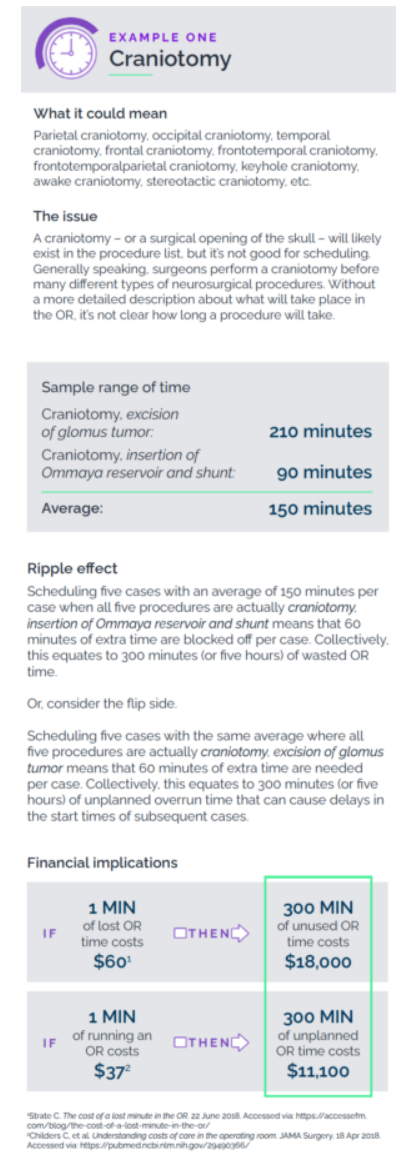
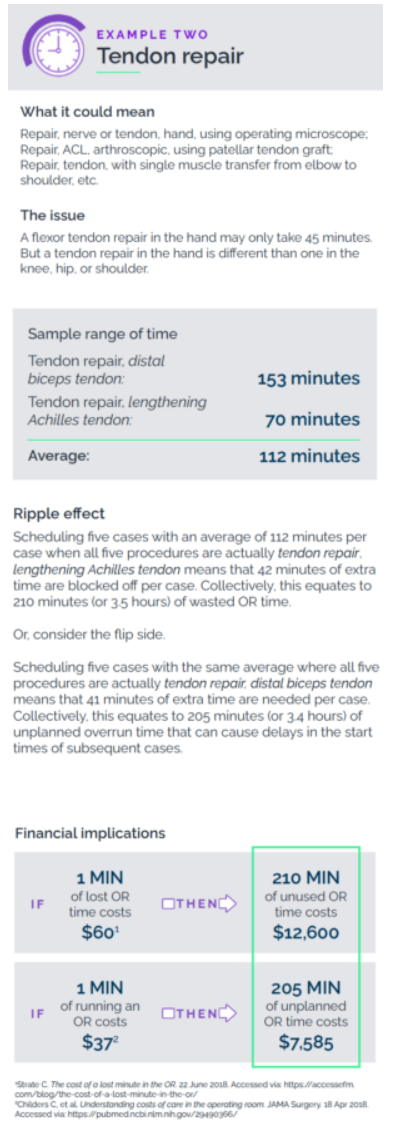
In many cases. It’s due to the fact that a health system’s surgical dictionary isn’t granular and detailed enough. For example, scheduling a hernia repair might be technically accurate-but is it a ventral hernia or a hlotol hernia? Will the case be open, laparoscopic, or robotic? While a ventral hernla repair takes an average of 30-45 minutes, surgeons need 2-3 hours to repair a hlatal hernia. Similarly, setting up a surgical robot doesn’t take the same amount of time as preparing the OR for an open case.
And things become even more complicated when multiple procedures are performed during the same operation. In these instances. It’s not necessarily accurate to average each individual procedure to estimate a case duration that would mean that time for setup and beginning or ending the procedure is counted twice.
In short, having detailed and robust terms for scheduling cases-being able to plan for a robotic ventral hernio repair or a laparoscopic hiatal hernia repair with Nissen fundoplication – is the secret to smooth surgical scheduling.
How did we get here?
For the ordering clinician, vague or generic terms may be fine since they likely have patient context, history, and information top-of-mind as they plan for surgery, Therefore, they know the specifics of the procedure they’re planning to perform and a generic term can be a “good enough”

.png)
.png)
.png)